Categories
City of Muscatine Press Releases

New LIve Fire Training Facility being fabricated by MFD

MUSCATINE, Iowa – Work is underway to construct a new live fire training facility using Conex containers at Muscatine Fire Department Station 2 off of Stewart Road. The facility will be a cost savings to the department and replace the procurement and use of old mobile homes for Fire Academy training.

The purchase of three Conex containers was approved by the Muscatine City Council during their March 16 meeting with the $9,485.00 cost being covered by American Rescue Plan Act (ARPA) funds.

In his memo to the City Council, Battalion Chief Darrell Janssen said that Conex containers have proven to be a very effective way of creating a training facility that can be used for multiple live fire training scenarios. 

“These containers can be modified and converted into various training props, which includes live fire rooms that can simulate real life situations,” Janssen said. “Creation of a live fire training facility like this has been a department goal for years as it provides flexibility, realistic training opportunities, and has a lower environmental impact than what we have had available for use in the past.” 

“I would like to say thank you to the Fire Chief, mayor, city administrator, and city council for making this possible,” Captain Andy Summitt said.

Summitt and Lieutenant Andrew McSorley have been heavily involved in the investigation and development of a live fire training facility.

“Many on staff spent hours preparing the trailers we were using for fire training, putting up drywall, fixing the floors, and prepping for the live burns,” Summitt said. “It was a costly, time-consuming process. We knew that there had to be a better way, one that was more durable and less costly.”

McSorley added that many departments are now going to these Conex boxes to burn in.

“They are safer, easier, last forever, and really cheap,” McSorley said.

Summitt, McSorley, and firefighter Sean Paustian were among those that started visiting other departments and seeing what they have done, including the facility at Iowa City, taking pictures and measurements to develop the basic layout for Muscatine. 

“Iowa City facility graciously gave us all the help we needed along with input,” Summitt said. “We will work to have them come down and instruct us how to do the burns so that we can get the most bang for our buck.”

Staff continued with their research by calling and visiting other departments to see what they were doing, what worked, and what didn’t.

“We learned a lot for our design from the problems they encountered,” McSorley said. “Some departments don’t even burn in them, but just smoke the trainees out with a smoke machine.”

McSorley took all the information, sat down with paper and a ruler, and drew out the design for the Muscatine live fire training facility. 

“We are getting to be such a young department that, if we are going to do it right, we might as well design it so that we can burn in it,” McSorley said. 
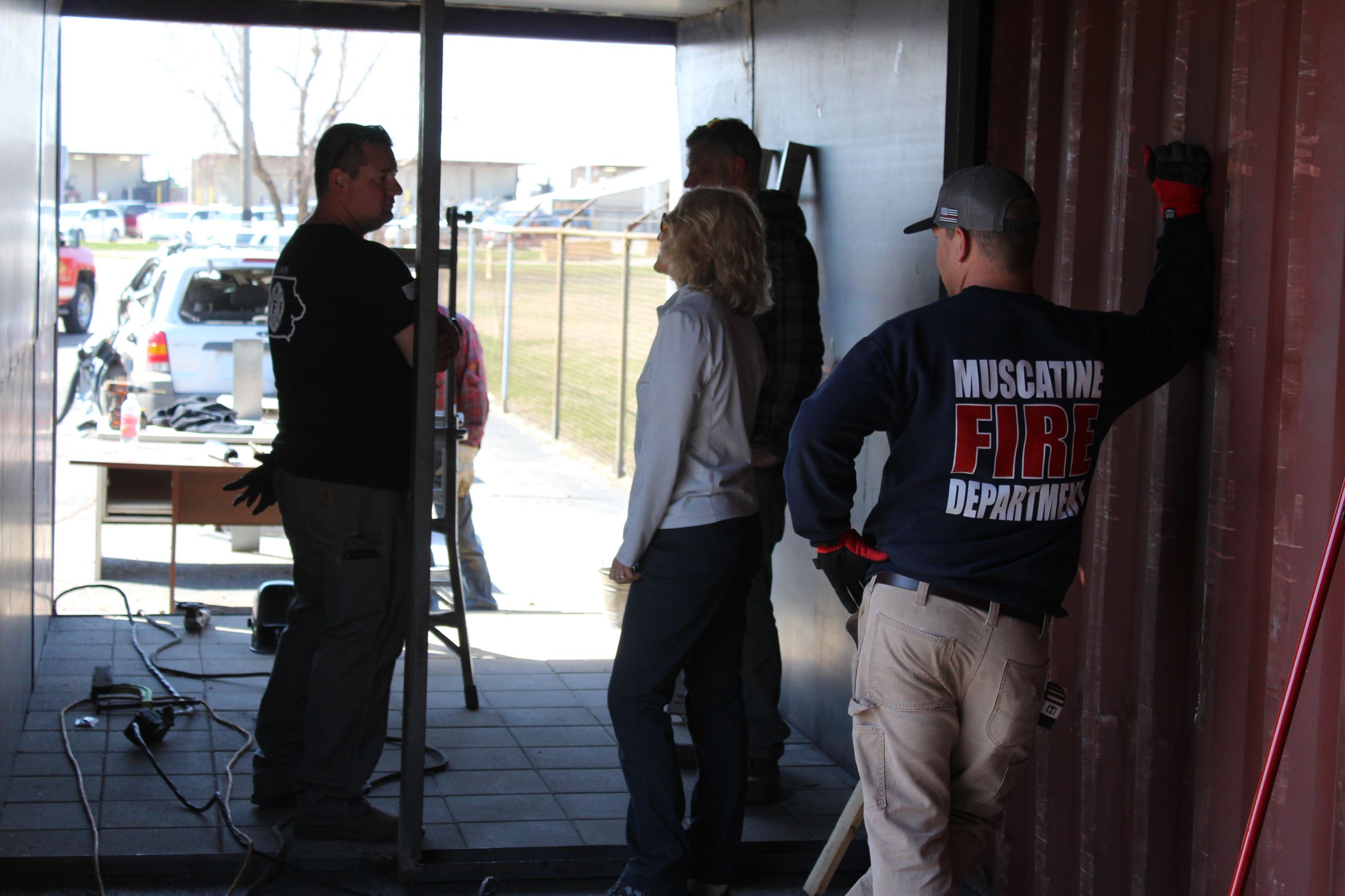
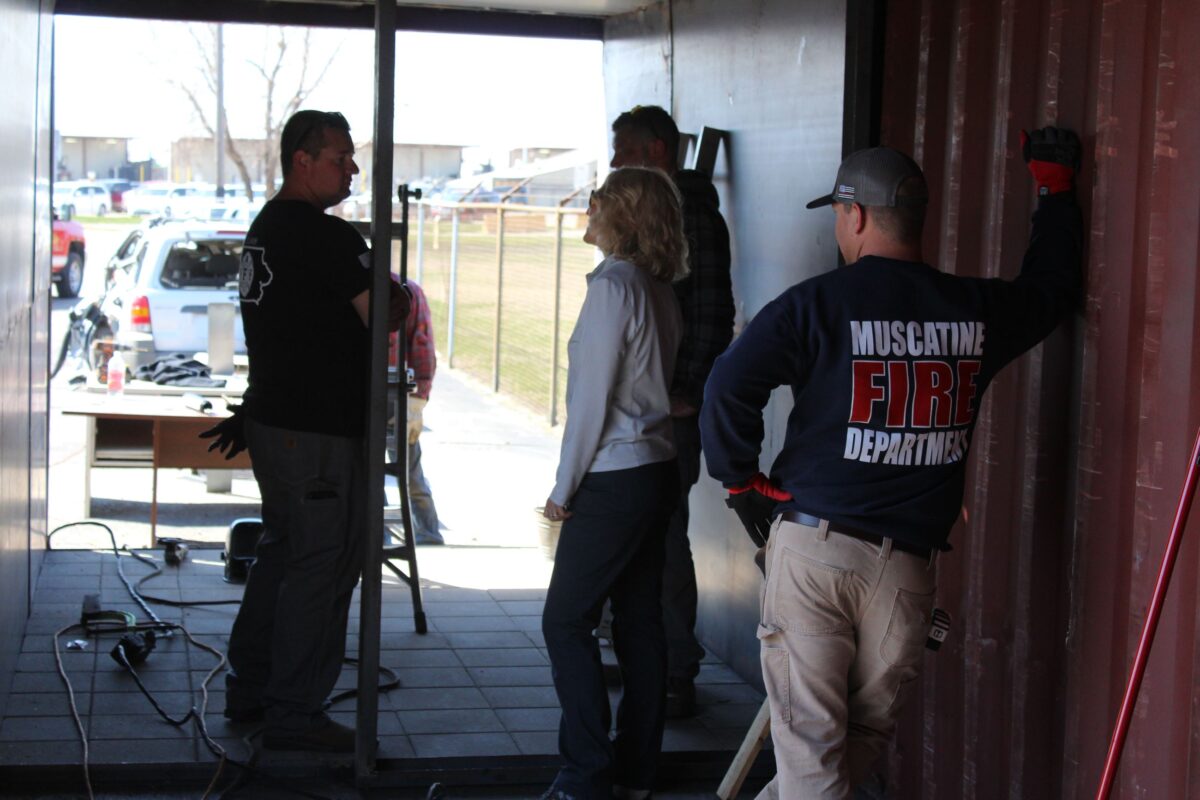
Fire Training Facility - discussing the layout (JPG) 04-11-23

When the first box arrived at the training site located at the old armory next to Station 2, it was discovered that the concrete pad had an arch to it. That meant that one end of the 8-foot x 40-foot container was 16-inches off the ground. With a team effort that is not unique for the City of Muscatine, Tyson Wedekind, the Roadway Maintenance Supervisor in the Department of Public Works, had his staff deliver and prep a level pad made up of crushed asphalt for the container.

“They had to pull off for other assignments but will be back in the next couple of weeks to create pads for the other two trailers,” McSorley said.

Public Works is not the only partner in the development of the training facility as the Fire Department has received help from Hoffmann, Inc., and MUSCO.

“Hoffmann donated two guys to us and a welder, which is amazing from them,” Summitt said. “I cannot thank them enough for that. And MUSCO provided their fork lift truck to help us place the containers.”

Kris Lee, president of Hoffmann, Inc., was on site Tuesday to see how the work was progressing. McSorley was hired by Hoffman while he was still in college and worked there until eight years ago when he decided to follow his lifelong dream to become a firefighter.

“I have known Andrew for a long time and when he reached out to us, we were happy to help,” Lee said.

McSorley noted that the expertise and equipment that Hoffman has donated to the fabrication of the facility is saving the department thousands of dollars, and a lot more in man hours.
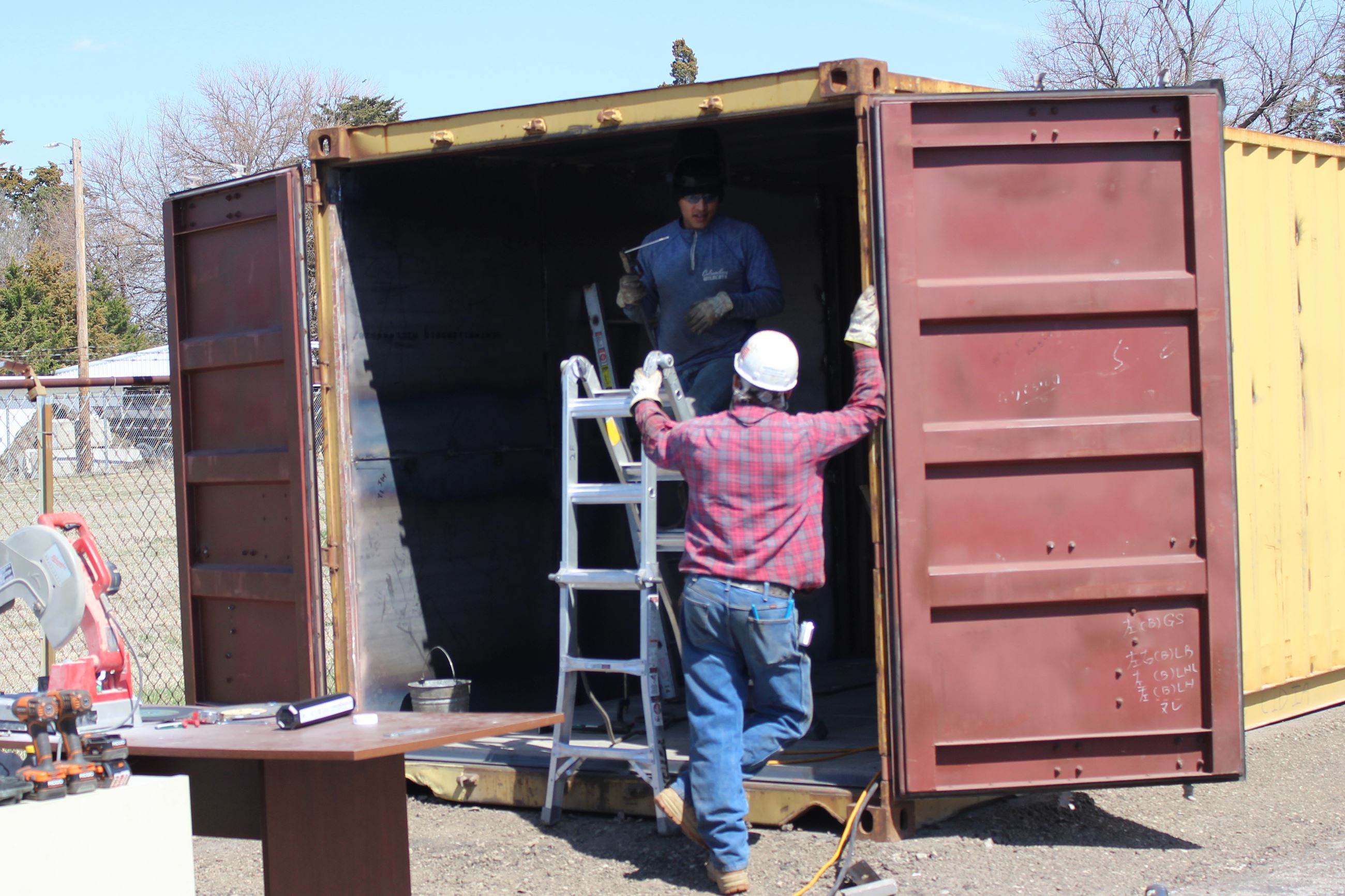
Fire Training Facility - Welding in Container 1 (JPG) 04-11-23 The first container being worked on will house the burn room, a section of the container that has to be built to certain specifications and is lined with steel on the sides, the top, and on the bottom to absorb the heat of the fire. Behind that will be the control room where the instructors will maintain the fires.

“The heat inside one of these things is insane,” McSorley said. “We are going to have to put special covers on our helmets and use our older gear during the exercises.”

A second box will fit perpendicular to the first box with a third box sitting alongside the second box when the first phase of the facility has been completed. Both of these will be used to simulate rooms in a home or entrances to a home.

The second and third containers will have ports cut into the side so a pipe can be inserted to dispense smoke and keep the smoke machine outside. Plans also include using the piping of smoke into additional containers as the facility rises vertically and horizontally.

“There will be days with our academies when we will just pump these units full of smoke and let the trainees do searches,” McSorley said. “We will build walls in them to simulate rooms. An end to one container will look like the front of a house with a door, and the end of another container will look like a window with plexiglass in it so we can do vent and search.”
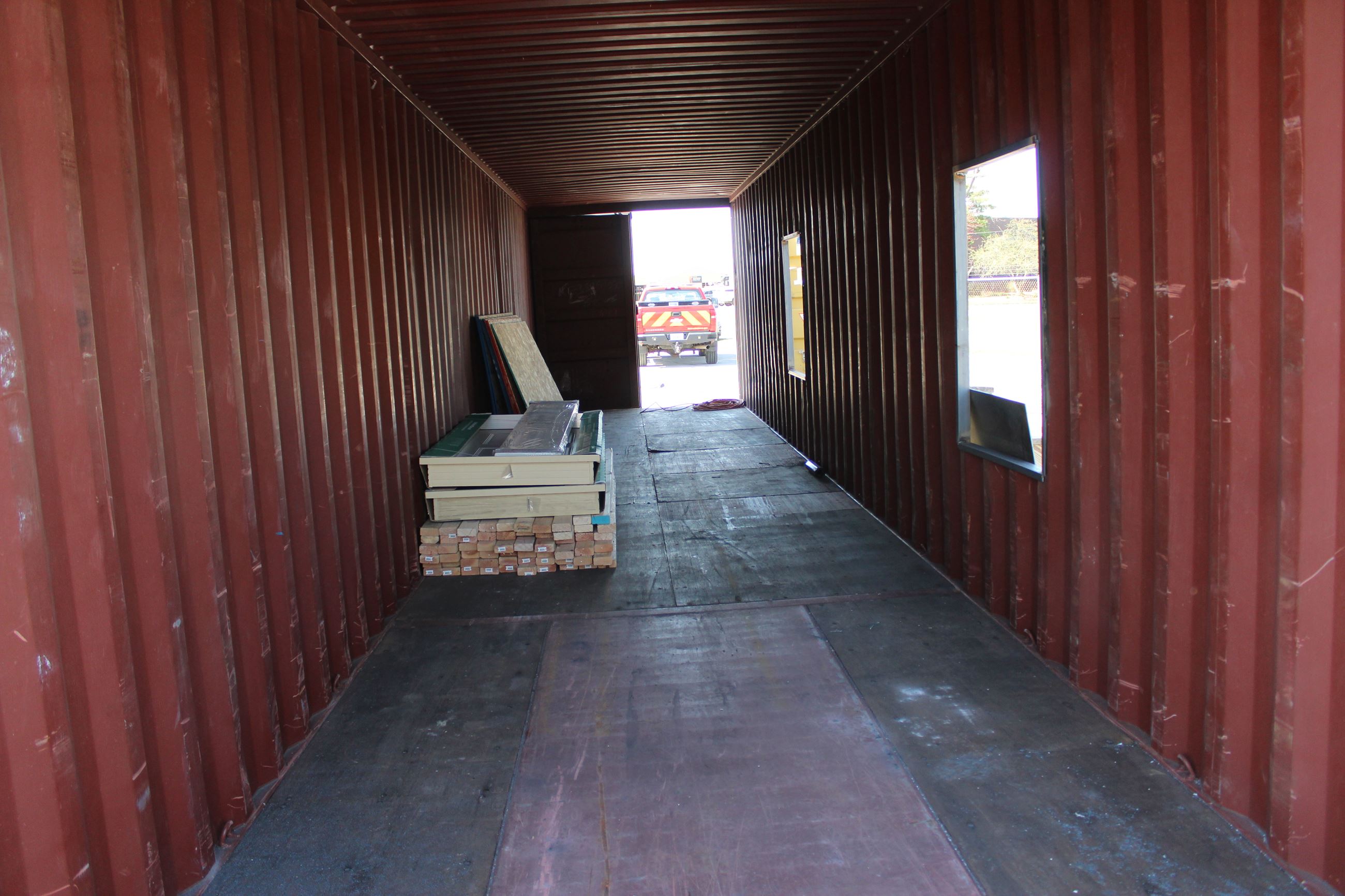
Fire Training Facility - Construction material (JPG) 04-11-23 Paustian did construction before becoming a firefighter and will be constructing the rooms in the interior portions of the second two boxes. Plans include building a couple of closets and a bathroom that the trainees will have to open up and search through.

McSorley recalled four or five winters ago that a department in the general vicinity missed a child that was in a closet. 

“For me, I’ve got two little kids, and that hit home,” McSorley said. “That is something that, in my academies now, we really hit hard on searches, especially in places that you don’t think of looking into.”

The current academy trainees will finish with the county burn trailer since the new facility will not be ready in time.

“This will be permanent training facility,” Summitt said. “My vision is that in the next couple of years we will go up maybe two-, three-, and four-stories high. We can stack them to make an upstairs, and to simulate basements. You can even stack them vertically to simulate elevators that you can repel down into. It will be the future training ground for sure.” 

To comment, provide a suggestion, or notify the city of an issue please visit MUSCATINE CONNECT, powered by SeeClickFix, or download the app from the Apple App store or Google Play. For more information visit CITIZEN REQUEST

Categories
City of Muscatine Press Releases

Taylor Park pickleball courts are ready for action

MUSCATINE, Iowa – Construction of one of Muscatine’s newest recreational amenities has been completed, and the facility is ready for use by the cities pickleball enthusiast. The six courts are located at Taylor Park just off of Franklin Street in Muscatine’s southend.

The recreational improvements at Taylor Park are part of the South End Improvement Project and include the pickleball courts, a new shelter, a parking lot, a splash pad, new playground, new lighting, and the installation of a modular restroom facility. However, only the pickleball courts are ready for use.

A soft opening is planned for Saturday with the courts available for drop-ins to use. Players are asked to rotate use of the courts when the facility is busy to allow everyone a chance to compete on the new surfaces. The park hours are 5 a.m. to 11 p.m.

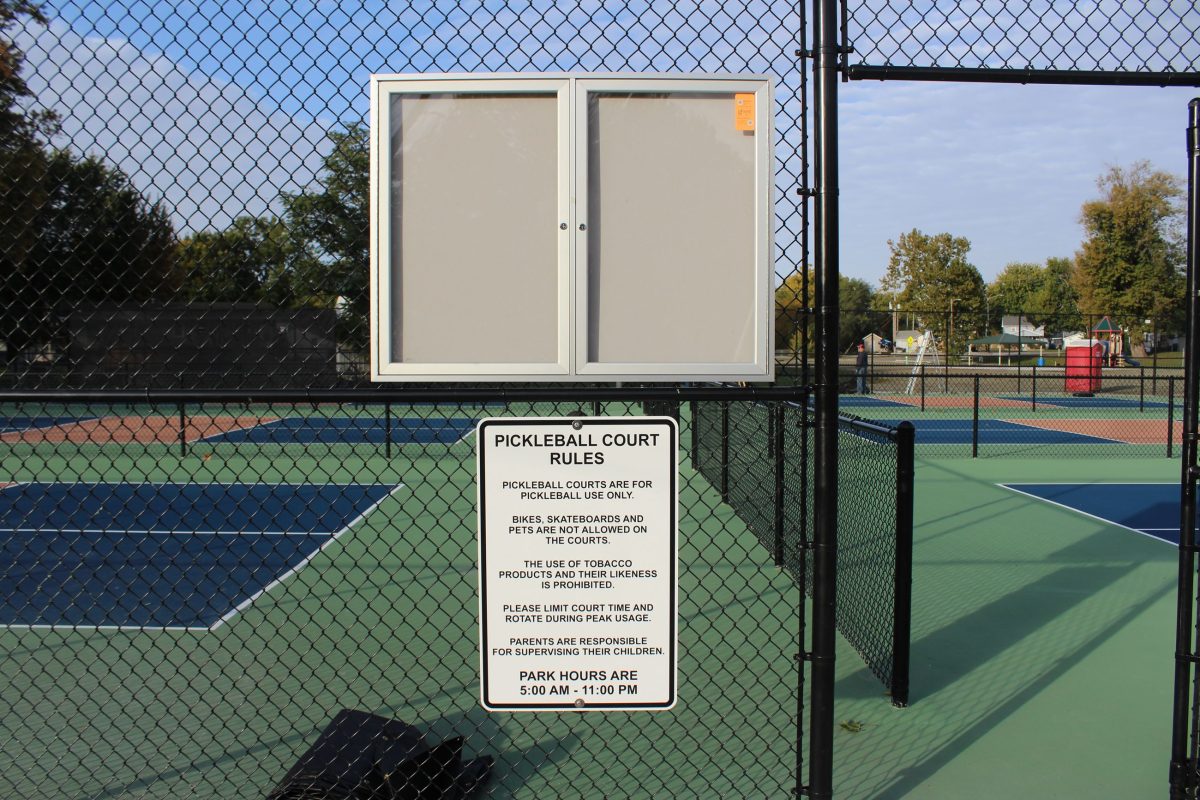
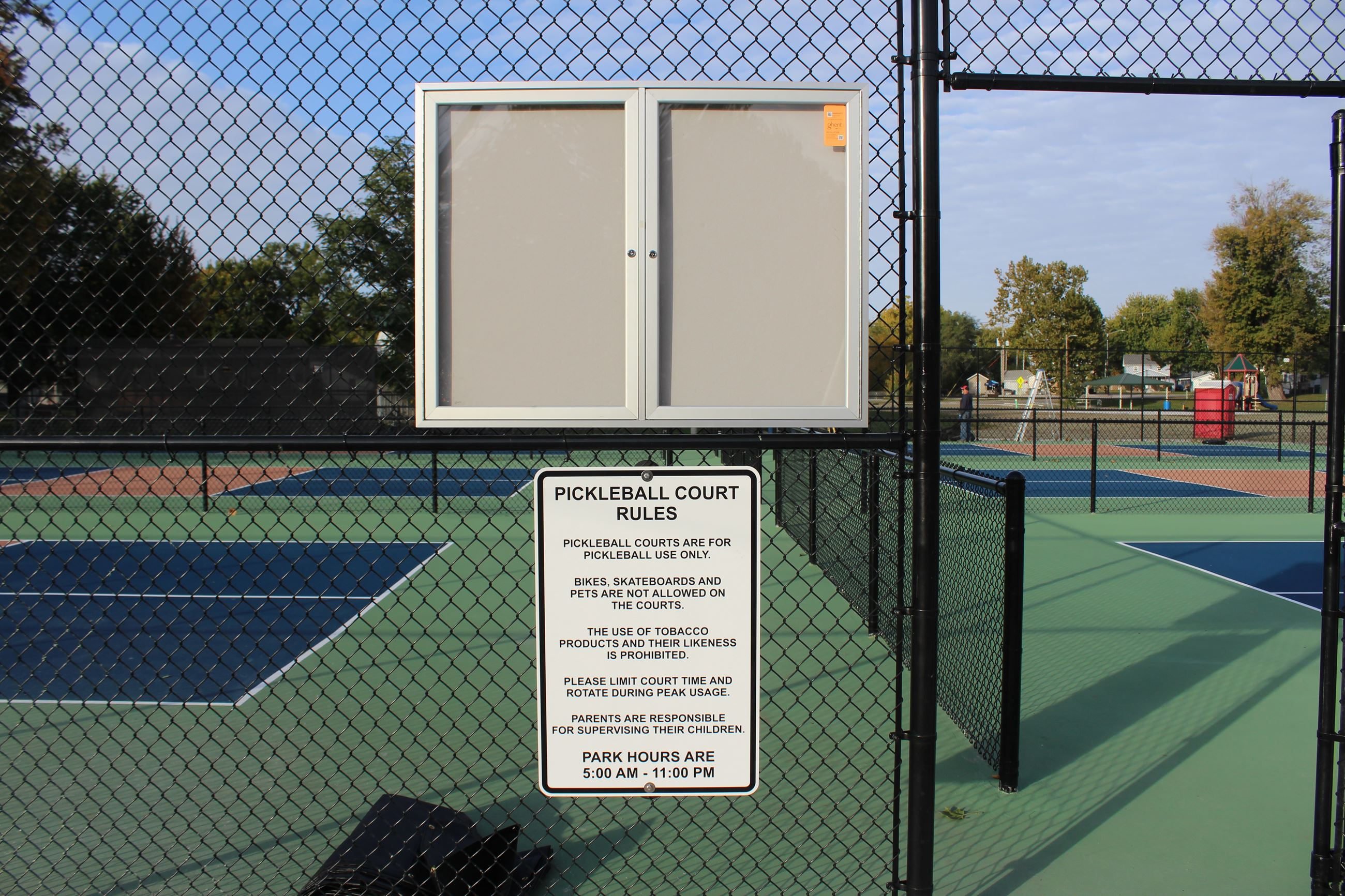
Displayed near the entrance to the courts are the Pickleball Court Rules that include:

  • Pickleball courts are for pickleball use only.
  • Bikes, skateboards and pets are not allowed on the courts.
  • The use of tobacco products and their likeness is prohibited.
  • Please limit court tie and rotate during peak usage.
  • Parents are responsible for supervising their children.

Taylor Park PIckleball Court Kiosk and Rules at entrance (JPG)The rest of the park remains a construction zone and the public is advised to stay out of the areas that have not been completed as yet. The installation of the modular restroom and the completion of the splash pad are expected later this year, and the installation of the new playground equipment is tentatively planned for next spring. The timing of the completion is depending on the weather and supply chain issues.
Categories
City of Muscatine Press Releases

WRRF has new tool to reduce nutrients, fight struvite formation

MUSCATINE, Iowa – The Muscatine Water & Resource Recovery Facility (WRRF) has a new tool to battle against struvite buildup … algae. The WRRF is taking part in a pilot study that uses growing algae as a way to reduce nutrients in wastewater.


“Algae is a wonderful way to take nutrients out of water,” Jon Koch, WRRF director, said. “They do that naturally anyway, taking nitrogen and phosphorus from the water to grow more of themselves.”


Gross-Wen Technologies, based in Slater, Iowa, developed a sustainable water treatment solution that was algae based, and a pilot program was established in early April at the WRRF and is now operational.


The process was developed by a graduate student and professor at Iowa State University as a way to remove the nutrients from lagoons and similar places.


“I was at a conference in Ames a few years ago when they presented this process,” Koch said.


What started as a process for lagoons attracted the interest of wastewater people and how this process could be used at wastewater plants. The thought of using algae to treat wastewater was new to the group presenting the process at the conference, and it took a few years of development to bring the costs down to a more manageable level.


The company visited the WRRF in 2019 and proposed a pilot program for Muscatine.


“We kind of lost track of the company during the pandemic but when we got slammed so badly by struvite in 2021, I called them up and said we needed to revisit bringing a pilot program to Muscatine,” Koch said.


The original cost for the six-month project was $100,000, but after some refinements to the process the cost was whittled down to $30,000.


“That is a lot more manageable,” Koch said. “During the revisit I asked them if we could get a pilot program right away and they said they could. However, it still took several months before the mechanism was delivered and installed.”


Struvite is a phosphate mineral crystal that is composed of magnesium, ammonia, and phosphate (referred to as MAP by the wastewater industry for the nutrient composition of struvite). Struvite is a common problem in sewage and wastewater treatment because it forms a scale in pipelines, belts, centrifuges, pumps, clog system pipes, and anaerobic digester systems. Damage to equipment, pipes and piping can lead to biosolids treatment mechanical and process failures. 


To reduce the problems caused by increased struvite levels in wastewater, a “Revolving Algal Biofilm System (RAMTM)” was developed for algae-based nutrient recovery from wastewater. The system also provides a cost-effective solution that can be used to comply with new, more stringent municipal and industrial wastewater discharge permits.


“This mechanism sits outside in a kind of greenhouse using the sun to keep the interior warm for good algae growth,” Koch said. 


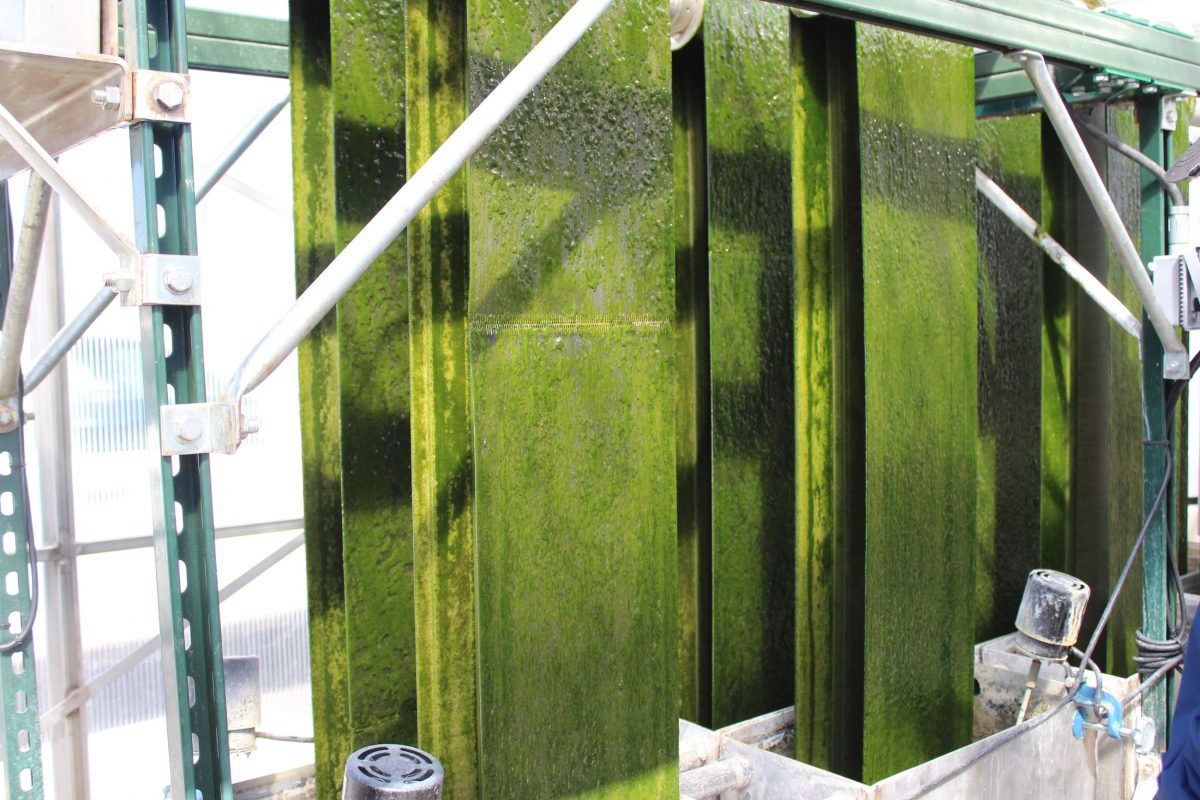
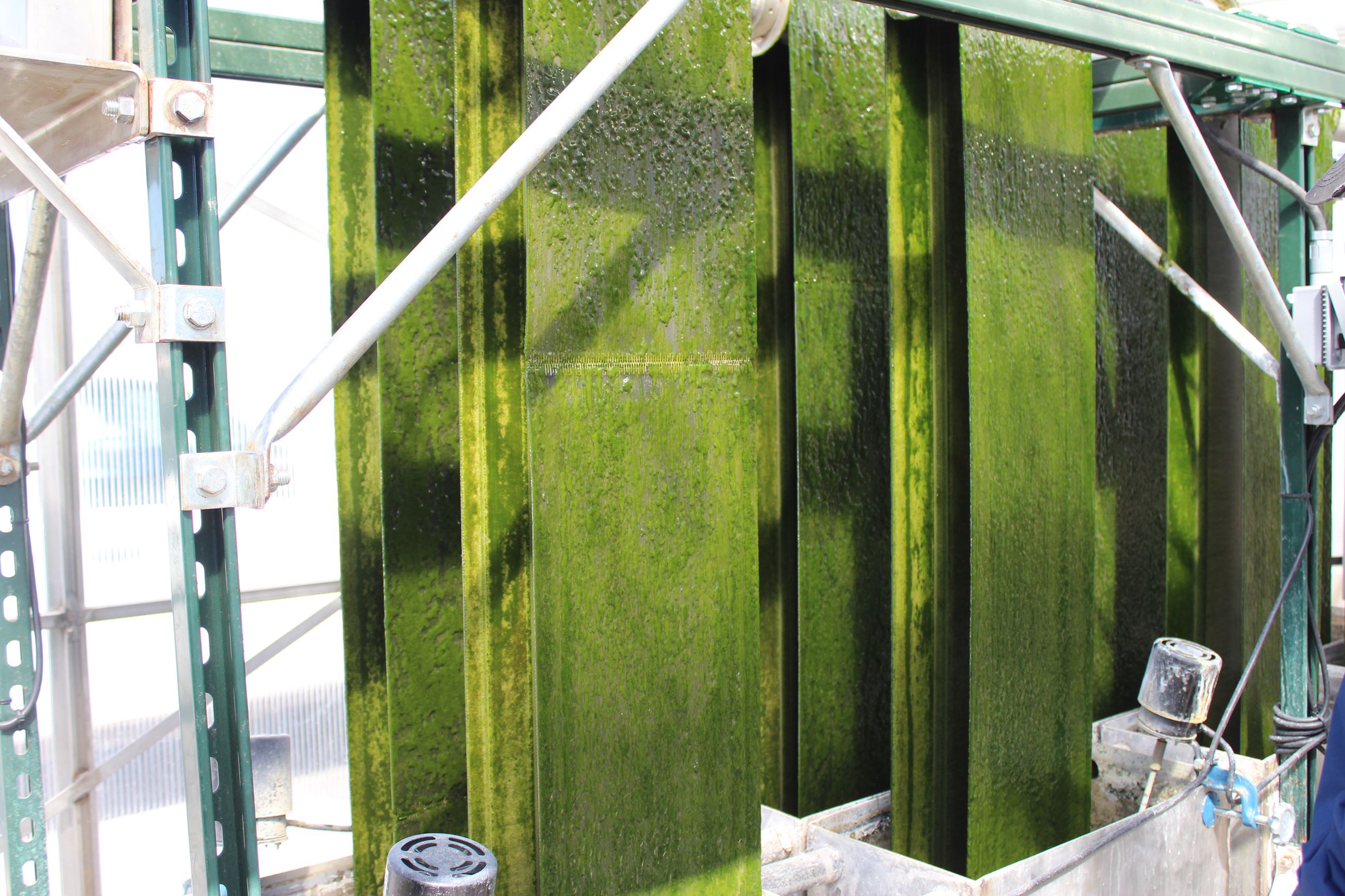
041922 Algae System at WRRF 04 (JPG)The system uses vertically oriented conveyor belts that grow algae on their surface. As the algae grows, it consumes nitrogen and phosphorus from the wastewater while it uses sunlight and carbon dioxide from the atmosphere to rapidly grow algae biomass.
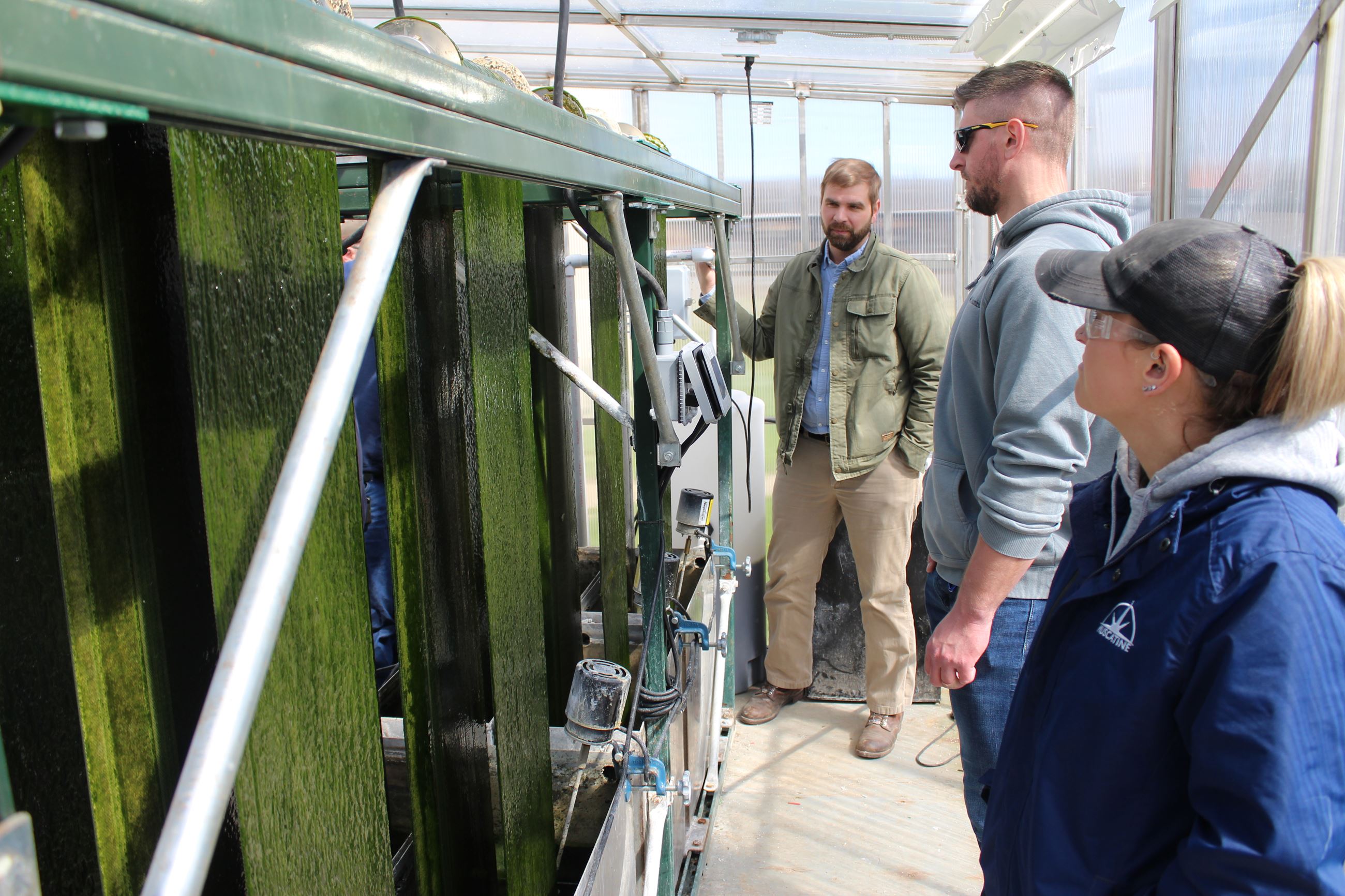
 

“The belt rotates through the effluent water and grabs nutrients from the wastewater,” Koch said. “Algae grows on the belt as it rotates up into the warm air. The algae picks up more nutrients as the belt continues to rotate back down, through the water, and back up.”


Algae is harvested by being scrapped off the belt, and can be used to make fertilizer, bioplastics, and biofuels, providing an additional revenue stream alongside an already more economical system.


“All that scraped off algae has the nutrients in it and the water that comes out has less nutrients than when it came in,” Koch said. “The mechanism also puts oxygen in the water using a six hp motor.”


Oxygen is needed by the bacteria to allow biodegradation to occur (breaking down the organic matter containing carbon to form carbon dioxide and water). At the present time, Koch is using three 150 hp and two 250 hp motors to add oxygen to the water. 


“If I can use 6 hp to add oxygen instead of 800 hp I am saving a lot of electricity,” Koch said.


The system benefits the WRRF by reducing the amount of nutrients in the water thus reducing the amount of struvite formation while meeting the more stringent DNR permit requirements and saving the WRRF money.


“So, you are meeting your permit limits for the nutrients you are required to take out, you are saving electricity, you are reducing struvite formation, you are reducing the amount of solids because it will pull solids out as well, and you have a revenue source,” Koch said. “This system kind of hits on a lot of different goals that we have.


Koch noted that using an algae-based system to remove nutrients from the water would quickly pay for itself.


“The savings you would have on energy reduction, and on the amount of time, energy, and chemicals used to prevent struvite formation along with the additional revenue from algae generation make this technology affordable,” Koch said.


But it is not only in the benefits of nutrient reduction to prevent struvite formation and to meet DNR permit requirements that make the system practical.


“This will be a really good compliment to the watershed work,” Koch said. “What this system can do for us as far as struvite removal is key, but you don’t have to do the whole thing (nutrient removal) at the plant.”


Koch noted that it would take an acre or more of these systems put together to do all the nutrient reduction and the cost would be pretty high.


“But if you scale it just where you need it, just enough to affect your struvite reduction and everything else, then maybe you can get most of that reduction done at the plant,” Koch said.


And whatever you cannot get done at the plant, then you can go out to the watershed, put in prairie strips and things like that, and do other watershed work which is really inexpensive but beneficial to the entire watershed.


“Muscatine city, the watershed as a whole, and the entire city basin will benefit from what we are starting to do at the WRRF today,” Koch said.


041922 Algae System at WRRF 01 (JPG)WRRF RAM System Pilot Program installed at Water Resource & Recovery Facility (Video)


 

Gross-Wen Technologies RAM System Overview (YouTube Video)


Gross-Wen Technologies RAB System (YouTube Video)


Categories
City of Muscatine Press Releases

Muscatine Compost Facility to open for season on March 19

MUSCATINE – Iowa – The Compost Facility at the Muscatine Transfer Station, 1000 S. Houser St., Muscatine, will open for the season on Saturday, March 19, according to David Popp, Solid Waste Manager for the City of Muscatine. Regular hours for the Compost Facility are 12-6 p.m. Sunday through Friday and from 9 a.m.-6 p.m. on Saturdays.


Muscatine and Fruitland residents can take yard waste (grass clippings, leaves, plants) from their property to the facility along with brush and branches less than 10 inches in diameter and 10 feet in length. Larger trees and logs can also be taken to the location but tree stumps or roots are not accepted.


Non-residents and commercial users of the Compost Facility will be charged a fee for yard waste brought to the site. The fee schedule for non-resident and for commercial users is available on the Compost Site page on the City of Muscatine web site. 


City of Muscatine resident window sticker (JPG)Residents of Muscatine and Fruitland can visit the Muscatine Transfer Station, Muscatine City Hall Finance Department, or the Muscatine Public Works Department to receive a window sticker to verify that they are a resident and will not be charged a fee at the Compost Facility by the attendant. A driver’s license with current address will be needed to verify residency. Each resident will receive a sticker for up to two vehicles which should be placed in the lower right hand corner of the windshield. 


An attendant will be on site to verify residency and secure payment from non-residents and commercial users (cash or check only with no bills larger than $20.00) during Compost Site operating hours.


The facility does not have compost available at the present time. Please call (563) 263-9689 in advance to find out when compost is available and at what times compost can be picked up.


Help loading compost will be offered on weekdays from 12-3:30 p.m. but limited to the availability of staff. Loading of mulch on Saturday and Sunday will be up to the individual as staff will not be available to help.


If you do not want to pick up compost at the facility, the Transfer Station will be offering a delivery service, but deliveries of shredded mulch, wood chips, and compost (when available) would need to be prescheduled by calling the Transfer Station. Deliveries would be limited to Muscatine and Fruitland residents on their trash collection day and limited to time available. A full one-ton truck load would cost $25.00.


The Compost Site also has firewood available for area residents. However, those wanting firewood are asked to check in with the attendant at the Compost Site and sign a waiver before cutting and/or loading firewood. 


Popp reminds residents wanting to bring material to the compost site that all loads need to be secured during transportation to or from the compost site as loose material may fall onto city streets causing traffic hazards or damage to vehicles. 


Compost Site Fee Schedule 2022

Non-Resident Fee Schedule


Commercial Users Fee Schedule

Per 

Bag


$1.00


Pickup


$30.00

Car/Van/

SUV


$5.00

Trailer

Up to 10-feet


$50.00

Small 

Pickup


$10.00

Trailer

10-16 feet


$100.00

Full Size 

Pickup


$12.00

One Ton

Dump Truck


$50.00

1 Ton Small 

Dump Truck


$15.00

Single Axle

Dump Truck


$75.00

Single Axle 

Trailer


$15.00

Tandem Axle

Dump Truck


$100.00

Tandem Axle 

Trailer


$30.00

Semi

Dump


$150.00

Single Axle 

Dump Truck


$40.00


Tandem Axle 

Dump Truck


$60.00


Semi 

Dump


$100.00


Pickup of shredded mulch, wood chips, and compost (when available)

Load Out Fee

$5.00 per cubic yard


Load Out Fee

$5.00 per cubic yard

Delivery of shredded mulch, wood chips, and compost (when available)

Muscatine and Fruitland Residents Only

$25.00 for a full one ton load